3/12/2007

Bo: US proposed tariff bill 'destructive' to trade


Commerce Minister Bo Xilai answers questions at a joint press conference with Zhou Xiaochuan, governor of the People's Bank of China or the central bank, on China's trade and monetary policy in the Great Hall of the People March 12, 2007. [Xinhua]

The trade between China and the United States is basically balanced and mutually beneficial, with the surplus going to the Chinese and the profits flowing to the Americans, said Commerce Minister Bo Xilai Monday.

The total sales of US-funded enterprises in China and their exports, using China as a base, to other parts of the world stood at US$110 billion, said Bo on the sidelines of the annual session of China's parliament.


Combining this figure with America's surplus in service trade and deficit in goods trade, one can find that the trade between the two countries is balanced, noted the minister. China's trade surplus with the US exceeded US$140 billion last year.


He pointed out that the bilateral trade is mutually beneficial, with the surplus going to the world's fastest growing major economy and the profits flowing to the world's most powerful nation.


"Only because of mutual benefit could the Sino-US trade be going smoothly, expanding all the way and doing better and better," said Bo.


"The US traders are wise and we have no grounds for suspicion. They will not do business with China if they can not make profits," Bo said.


Bo reiterated the country's opposition to a 27.5 punitive tariff proposed by some US lawmakers on all Chinese exports.


"If the proposal goes ahead, it will be destructive to the current bilateral trade which is developing healthily, as well as disastrous news to both countries' enterprises that have achieved double-win in the relationship," said he.


The minister believed the slap of the tariff, if passed, is out of line with WTO rules.


"If such a policy is enforced, it is not only trade protectionism, but also trade hegemony," noted Bo.


Doha round of talks


On the increasing trade frictions between China and major trading partners, especially the US and EU, Bo said he hoped that most of the problems could be solved through talks. But China will also respect the related parties' choice to turn to the WTO mechanism.


Bo pledged to make active contributions to the Doha round of talks which hit snags due to developed countries' reluctance to reduce agricultural subsidies and tariff.


China has done a lot for the WTO multilateral mechanism, said Bo. China's overall tariff level stands at 9.9 per cent, compared with the world's average of 39 per cent; China's tariff on non-agricultural products is 9 per cent while the world's average is 29 per cent; China levies 15 per cent for agricultural imports while the world collects an average of 60 per cent, elaborated he.


On China's opening of service trade which is often criticized by the western countries, the minister revealed that China has opened up 100 of the 160 categories specified by the WTO rules, 46 more than the average of 54 for developing economies. "The US has opened just one more than US. Therefore, China has shown a lot of courage."


Trade with Africa defended


Bo rejected the western countries' criticism of China's trade with the African countries, asking the Europeans and the Americans to examine themselves before criticizing China.


"An important criticism is that China is taking oil from Africa. But according to statistics, out of Africa's total oil export last year, China accounts for a mere 8.7 per cent, compared with 36 per cent for Europe and 33 per cent for the US, " said Bo.


"If 8.7 per cent of the import is an exploitation of resources, then how should we look at 36 per cent and 33 per cent?" asked the minister.


He went on to quote some African leaders as saying that it was only after China entered the Africa and engaged in more trade with the continent that some resources in Africa began to display their real market value, implying that the resources were taken away at very low prices before.


"China is doing reasonable, fair businesses at just market prices with African countries," said Bo.


Central bank vows to fight inflation


Central bank governor Zhou Xiaochuan pledged to contain inflation at the joint press conference with Bo to ensure that the purchasing power the Chinese do not decrease.


Zhou Xiaochuan, governor of the People's Bank of China or the central bank, answers questions at a joint press conference with Commerce Minister Bo Xilaion China's trade and monetary policy in the Great Hall of the People March 12, 2007. [Xinhua]

"For the central bank, the importance of this can not be overemphasized, " said Zhou.

The country's consumer price index might have grown 2.8 per cent in January, according to a poll of 21 economists by Bloomberg News. The projected growth is just slightly lower than the 3 per cent annual target of the central bank, fueling speculations that Zhou's administration will increase the interest rate.


Zhou promised that the country's monetary policy would be more transparent and predicable, or more in consensus with the public and the industries. "This is the major trend."


However, he did not expect the future policies to accord with all schools of economists. "When a policy is out, some will say it is in line with their expectations, but others believe it is a surprise," said he.


In addition, Zhou said his bank does not hope to see the launch of a certain monetary policy helps speculative activities as it will give a bad signal.


The recent Chinese stock market plunge was not caused by changes in the economic fundamentals and is unlikely to lead to major trend changes, said the governor. China's stock market fell nearly 9 per cent February 27, the largest one-day fall in a decade, followed by a global stock market sell-off.


That showed the growing integration of Chinese and global equity market, said Zhou, vowing to further develop the country's capital markets.


When asked to offer some advice for investors, he suggested retail investors reading some books on finance, which will help them allocate their investments.


China's stock market witnessed a bullish run last year, growing more than 130 per cent. Millions of Chinese are pouring their money into the equity market for the limited number of quality shares, pushing up the prices.


The shares in the Shanghai Stock Exchange and Shenzhen Stock Exchange are trading at 33 times earnings on average, well above the 15 in developed western markets, fueling talks of bubbles.



Mesothelioma: Questions and Answers


Mesothelioma is a rare form of cancer in which malignant (cancerous) cells are found in the mesothelium, a protective sac that covers most of the body's internal organs. Most people who develop mesothelioma have worked on jobs where they inhaled asbestos particles.


  1. What is the mesothelium?

    The mesothelium is a membrane that covers and protects most of the internal organs of the body. It is composed of two layers of cells: One layer immediately surrounds the organ; the other forms a sac around it. The mesothelium produces a lubricating fluid that is released between these layers, allowing moving organs (such as the beating heart and the expanding and contracting lungs) to glide easily against adjacent structures.


    The mesothelium has different names, depending on its location in the body. The peritoneum is the mesothelial tissue that covers most of the organs in the abdominal cavity. The pleura is the membrane that surrounds the lungs and lines the wall of the chest cavity. The pericardium covers and protects the heart. The mesothelial tissue surrounding the male internal reproductive organs is called the tunica vaginalis testis. The tunica serosa uteri covers the internal reproductive organs in women.


  2. What is mesothelioma?

    Mesothelioma (cancer of the mesothelium) is a disease in which cells of the mesothelium become abnormal and divide without control or order. They can invade and damage nearby tissues and organs. Cancer cells can also metastasize (spread) from their original site to other parts of the body. Most cases of mesothelioma begin in the pleura or peritoneum.


  3. How common is mesothelioma?

    Although reported incidence rates have increased in the past 20 years, mesothelioma is still a relatively rare cancer. About 2,000 new cases of mesothelioma are diagnosed in the United States each year. Mesothelioma occurs more often in men than in women and risk increases with age, but this disease can appear in either men or women at any age.


  4. What are the risk factors for mesothelioma?

    Working with asbestos is the major risk factor for mesothelioma. A history of asbestos exposure at work is reported in about 70 percent to 80 percent of all cases. However, mesothelioma has been reported in some individuals without any known exposure to asbestos.


    Asbestos is the name of a group of minerals that occur naturally as masses of strong, flexible fibers that can be separated into thin threads and woven. Asbestos has been widely used in many industrial products, including cement, brake linings, roof shingles, flooring products, textiles, and insulation. If tiny asbestos particles float in the air, especially during the manufacturing process, they may be inhaled or swallowed, and can cause serious health problems. In addition to mesothelioma, exposure to asbestos increases the risk of lung cancer, asbestosis (a noncancerous, chronic lung ailment), and other cancers, such as those of the larynx and kidney.


    Smoking does not appear to increase the risk of mesothelioma. However, the combination of smoking and asbestos exposure significantly increases a person's risk of developing cancer of the air passageways in the lung.


  5. Who is at increased risk for developing mesothelioma?

    Asbestos has been mined and used commercially since the late 1800s. Its use greatly increased during World War II. Since the early 1940s, millions of American workers have been exposed to asbestos dust. Initially, the risks associated with asbestos exposure were not known. However, an increased risk of developing mesothelioma was later found among shipyard workers, people who work in asbestos mines and mills, producers of asbestos products, workers in the heating and construction industries, and other tradespeople. Today, the U.S. Occupational Safety and Health Administration (OSHA) sets limits for acceptable levels of asbestos exposure in the workplace. People who work with asbestos wear personal protective equipment to lower their risk of exposure.


    The risk of asbestos-related disease increases with heavier exposure to asbestos and longer exposure time. However, some individuals with only brief exposures have developed mesothelioma. On the other hand, not all workers who are heavily exposed develop asbestos-related diseases.


    There is some evidence that family members and others living with asbestos workers have an increased risk of developing mesothelioma, and possibly other asbestos-related diseases. This risk may be the result of exposure to asbestos dust brought home on the clothing and hair of asbestos workers. To reduce the chance of exposing family members to asbestos fibers, asbestos workers are usually required to shower and change their clothing before leaving the workplace.


  6. What are the symptoms of mesothelioma?

    Symptoms of mesothelioma may not appear until 30 to 50 years after exposure to asbestos. Shortness of breath and pain in the chest due to an accumulation of fluid in the pleura are often symptoms of pleural mesothelioma. Symptoms of peritoneal mesothelioma include weight loss and abdominal pain and swelling due to a buildup of fluid in the abdomen. Other symptoms of peritoneal mesothelioma may include bowel obstruction, blood clotting abnormalities, anemia, and fever. If the cancer has spread beyond the mesothelium to other parts of the body, symptoms may include pain, trouble swallowing, or swelling of the neck or face.


    These symptoms may be caused by mesothelioma or by other, less serious conditions. It is important to see a doctor about any of these symptoms. Only a doctor can make a diagnosis.


  7. How is mesothelioma diagnosed?

    Diagnosing mesothelioma is often difficult, because the symptoms are similar to those of a number of other conditions. Diagnosis begins with a review of the patient's medical history, including any history of asbestos exposure. A complete physical examination may be performed, including x-rays of the chest or abdomen and lung function tests. A CT (or CAT) scan or an MRI may also be useful. A CT scan is a series of detailed pictures of areas inside the body created by a computer linked to an x-ray machine. In an MRI, a powerful magnet linked to a computer is used to make detailed pictures of areas inside the body. These pictures are viewed on a monitor and can also be printed.


    A biopsy is needed to confirm a diagnosis of mesothelioma. In a biopsy, a surgeon or a medical oncologist (a doctor who specializes in diagnosing and treating cancer) removes a sample of tissue for examination under a microscope by a pathologist. A biopsy may be done in different ways, depending on where the abnormal area is located. If the cancer is in the chest, the doctor may perform a thoracoscopy. In this procedure, the doctor makes a small cut through the chest wall and puts a thin, lighted tube called a thoracoscope into the chest between two ribs. Thoracoscopy allows the doctor to look inside the chest and obtain tissue samples. If the cancer is in the abdomen, the doctor may perform a peritoneoscopy. To obtain tissue for examination, the doctor makes a small opening in the abdomen and inserts a special instrument called a peritoneoscope into the abdominal cavity. If these procedures do not yield enough tissue, more extensive diagnostic surgery may be necessary.


    If the diagnosis is mesothelioma, the doctor will want to learn the stage (or extent) of the disease. Staging involves more tests in a careful attempt to find out whether the cancer has spread and, if so, to which parts of the body. Knowing the stage of the disease helps the doctor plan treatment.


    Mesothelioma is described as localized if the cancer is found only on the membrane surface where it originated. It is classified as advanced if it has spread beyond the original membrane surface to other parts of the body, such as the lymph nodes, lungs, chest wall, or abdominal organs.


  8. How is mesothelioma treated?

    Treatment for mesothelioma depends on the location of the cancer, the stage of the disease, and the patient's age and general health. Standard treatment options include surgery, radiation therapy, and chemotherapy. Sometimes, these treatments are combined.


    • Surgery is a common treatment for mesothelioma. The doctor may remove part of the lining of the chest or abdomen and some of the tissue around it. For cancer of the pleura (pleural mesothelioma), a lung may be removed in an operation called a pneumonectomy. Sometimes part of the diaphragm, the muscle below the lungs that helps with breathing, is also removed.


    • Radiation therapy, also called radiotherapy, involves the use of high-energy rays to kill cancer cells and shrink tumors. Radiation therapy affects the cancer cells only in the treated area. The radiation may come from a machine (external radiation) or from putting materials that produce radiation through thin plastic tubes into the area where the cancer cells are found (internal radiation therapy).


    • Chemotherapy is the use of anticancer drugs to kill cancer cells throughout the body. Most drugs used to treat mesothelioma are given by injection into a vein (intravenous, or IV). Doctors are also studying the effectiveness of putting chemotherapy directly into the chest or abdomen (intracavitary chemotherapy).


    To relieve symptoms and control pain, the doctor may use a needle or a thin tube to drain fluid that has built up in the chest or abdomen. The procedure for removing fluid from the chest is called thoracentesis. Removal of fluid from the abdomen is called paracentesis. Drugs may be given through a tube in the chest to prevent more fluid from accumulating. Radiation therapy and surgery may also be helpful in relieving symptoms.


  9. Are new treatments for mesothelioma being studied?

    Yes. Because mesothelioma is very hard to control, the National Cancer Institute (NCI) is sponsoring clinical trials (research studies with people) that are designed to find new treatments and better ways to use current treatments. Before any new treatment can be recommended for general use, doctors conduct clinical trials to find out whether the treatment is safe for patients and effective against the disease. Participation in clinical trials is an important treatment option for many patients with mesothelioma.


    People interested in taking part in a clinical trial should talk with their doctor. Information about clinical trials is available from the Cancer Information Service (CIS) (see below) at 1-800-4-CANCER. Information specialists at the CIS use PDQ®, NCI's cancer information database, to identify and provide detailed information about specific ongoing clinical trials. Patients also have the option of searching for clinical trials on their own. The clinical trials page on the NCI's Cancer.gov Web site, located at http://www.cancer.gov/clinical_trials on the Internet, provides general information about clinical trials and links to PDQ.


    People considering clinical trials may be interested in the NCI booklet Taking Part in Clinical Trials: What Cancer Patients Need To Know. This booklet describes how research studies are carried out and explains their possible benefits and risks. The booklet is available by calling the CIS, or from the NCI Publications Locator Web site at http://www.cancer.gov/publications on the Internet.


# # #


National Cancer Institute (NCI) Resources


Cancer Information Service (toll-free)

Telephone: 1-800-4-CANCER (1-800-422-6237)

TTY: 1-800-332-8615


Online

NCI's Web site: http://www.cancer.gov
LiveHelp, NCI's live online assistance:
https://cissecure.nci.nih.gov/livehelp/welcome.asp


3/11/2007

China to build airports in remote west


China reportedly plans to invest 52 billion yuan (6.7 billion dollars) in building 37 new airports and expanding 31 others in the west of the country over the next four years.


Citing China's civil aviation authorities, the People's Daily said that western areas of the country had only 38 percent of the nation's airports, and the need for more access to aviation was growing along with economic development.


Passengers wait in Beijing airport in February 2007. China reportedly plans to invest 52 billion yuan (6.7 billion dollars) in building 37 new airports and expanding 31 others in the west of the country over the next four years. [AFP]

The remote northwestern parts of the country were particularly deprived, it said, adding the construction plan would redress the balance with more affluent eastern areas of the country.


One of the new airports, to be built in Tibet, would be the highest in the world at over 4,000 metres (13,200 feet) above sea level, the newspaper said.


The Tibetan autonomous region has only two airports at present -- one near the capital, Lhasa, and the other in Qamdo prefecture.


The airport construction plan was agreed at talks last year between the General Administration of Civil Aviation of China (CAAC) and officials representing western province, the newspaper said.


They agreed to implement the plan during the current 2006-2010 state development plan, it added.


Lawmakers to speed up legislation on social issues


Wu Bangguo, chairman of the Standing Committee of the 10th National People's Congress, delivers a report on the work of the NPC in the Great Hall of the People in Beijing March 11, 2007. [Xinhua]

China's top legislature, the National People's Congress (NPC), will intensify its legislation focusing on social affairs this year, China's top legislator Wu Bangguo said Sunday. ( Wu Bangguo's Work Report)

"While continuing work to improve economic legislation, we must also concentrate on strengthening legislation related to social programs to provide a solid legal foundation for building a harmonious socialist society and to ensure attainment of the legislative goal of the 10th NPC," Wu said.

The NPC Standing Committee chairman unveiled the legislative plan for 2007 when delivering a report on the work of the 10th NPC Standing Committee at the legislature's annual full session.

The main legislative tasks this year include enacting the Law on Labor Contracts, Employment Promotion Law, Social Security Law, Law on Mediation and Arbitration of Labor Disputes, Law on Administrative Decrees, Law on Response to Emergencies, Antitrust Law, Law on State-Owned Assets, Law to Combat Illegal Drugs, Law to Curb Illegal Activities, Law on Urban and Rural Planning, and Circular Economy Law.
In addition, the legislature will revise the Law on Scientific and Technological Progress, Civil Procedure Law, Criminal Procedure Law, Law on Food Hygiene, Law on Energy Conservation, and Law on Attorneys, according Wu.

"We have noticed that a large proportion of the laws planned to be enacted or revised in 2007 target at regulating social affairs, " said Fu Yonglin, an NPC deputy from Sichuan Province.

For example, the draft employment promotion law, which was submitted to the NPC Standing Committee for reading in February, prohibits discrimination against job seekers despite their ethnicity, race, gender, religious belief, age or physical disability. And the governments above the county level are required to establish early warning systems to prevent, regulate and control possible cases of large-scale unemployment.

The draft law is urgently needed as the employment situation at present and in a long period to come is not optimistic, said Fu.

Wu Bangguo said the current NPC and its Standing Committee will achieve the goal of basically establishing a socialist legal system with Chinese characteristics and improving the quality of legislation before the current five-year legislative tenure ends in next March.

"Over the last four years, we passed amendments to the Constitution, the Anti-Secession Law, and formulated or revised 70 laws, judicial interpretations and legal decisions concerning legal issues,...thereby making very good progress in legislative work," the top legislator said.

China is in a critical period of reform and development, in which China's economic system and social structure, the interests of different sectors of society and people's thinking and concepts are all changing profoundly, he said.

"These unprecedented social changes provide very strong vitality for China's development, but they inevitably create a wide variety of conflicts and problems as well," Wu said, adding that the legislation work should always adhere to correct political direction and the principle of putting people first, base on China's actual conditions and realities and follow the mass line.

14 LAWS ADOPTED IN 2006

The NPC Standing Committee deliberated 24 draft laws and draft decisions on legal issues in 2006. Among them 14 were adopted and five were tabled to the ongoing annual session of NPC for deliberating.

The Law on Oversight, which is strongly political in nature, is related to the country's political system and system of government. Formulation of the Law on Oversight was one of the major legislative acts of the NPC. Work actually began on this law at the Sixth NPC and continued for the following two decades. The law was adopted last year.

The Law on Oversight "fully embodies the organic unity of the leadership of the Party, the position of the people as masters of the country and the running of the government according to the rule of law; correctly balances stronger oversight by people's congresses with the leadership of the Party;...upholds the principles of democratic centralism, collective exercise of functions and powers, collective decision making and acting in accordance with the law and prescribed procedures..." said Wu.

The NPC Standing Committee in August 2006 adopted the Corporate Bankruptcy Law, aiming to protect both creditors of bankrupt enterprises and the people who work in them. The law will come into effect on June 1, 2007.

The old bankruptcy rules, promulgated in 1986 on a test basis, were widely regarded as outdated as they fail to give sufficient protection to creditors and only touch on State-owned enterprises (SOE).

The new Corporate Bankruptcy Law applies to all kinds of enterprises and financial institutions. All the country's companies and enterprises, whether state-owned or private, will have to follow a unified corporate bankruptcy law if they founder.

In a bid to safeguard children's fundamental interests and ensure their healthy growth, the NPC Standing Committee revised Compulsory Education Law and Law on Protection to Minors last year.

Other important laws passed or revised last year include Anti- money Laundering Law, Banking Oversight and Management Law, and Organic Law of the People's Court, among others.

According to the revised Organic Law of the People's Court, the Supreme People's Court retrieved the right to review death penalty cases. This was widely regarded as an important step to ensure judicial justice.


How do I use a custom domain name on my blog?


Publishing on Blog*Spot is the fastest and easiest way to use all of Blogger's great features. (And for free, no less!) If you don't care to have blogspot.com in your blog's address, though, you can get a domain of your own. We'll continue to host all your content as before, but it will be displayed at your new address. (Unlike FTP publishing, which requires you to buy both a domain name and a hosting service.)


Your Domain


The first thing you'll need to do is to choose a domain name, like mysite.com and register it. You can register domain names from any of a number of different registrars, and you can use .com, .org, .net or any other valid addresses. Remember: you only need to get the domain name; you don't have to pay extra for hosting service.


DNS Settings


DNS stands for Domain Name System, and a DNS server determines what site a given address takes you to. So far, you have a domain name but none of the servers on the internet know what to do with it yet. To take care of this, you need to create a CNAME record for your domain with the DNS, associating your domain with ghs.google.com. The exact procedure for doing this varies depending on your domain registrar, but you can find instructions for many common registrars here. If yours isn't listed, or if you run into other difficulties, you can contact your registrar directly and they'll be able to help you out.


Once you've told one particular DNS server about your new domain, it will have to transfer that information to all the other servers on the internet, which could take a couple of days. So be aware that your new domain won't necessarily be working instantly.


Blogger Settings


Almost done! At this point, you have a domain name, and the DNS servers know to direct people to Google when they want to see your blog. But Google hosts lots of blogs, so we have to make sure the right one is associated with this domain. You'll do this on the Settings | Publishing tab for your blog in Blogger.


If you're publishing on Blog*Spot, you'll see a link near the top offering to switch you to a custom domain. Go ahead and click that link.


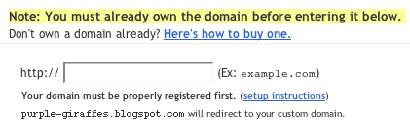
The Blog*Spot Address setting now changes to Your Domain. Fill in the domain you registered at the beginning of this process, then save your settings.


Now the only thing left to do is to tell everybody about your new address!


Notes:


  • If your new domain isn't taking you to your blog, wait another day or two, to make sure all the DNS servers have been updated. If it still isn't working, contact your registrar to make sure you entered the DNS settings correctly.

  • Your original Blog*Spot address will automatically forward to your new domain. That way, any existing links or bookmarks to your site will still work.

  • You can use this feature with domains (e.g. mysite.com) or subdomains (e.g. name.mysite.com). However, you cannot specify subdirectories (e.g. mysite.com/blog/) or wildcards (e.g. *.mysite.com).

  • Your posted images will continue to display on your blog as described here.